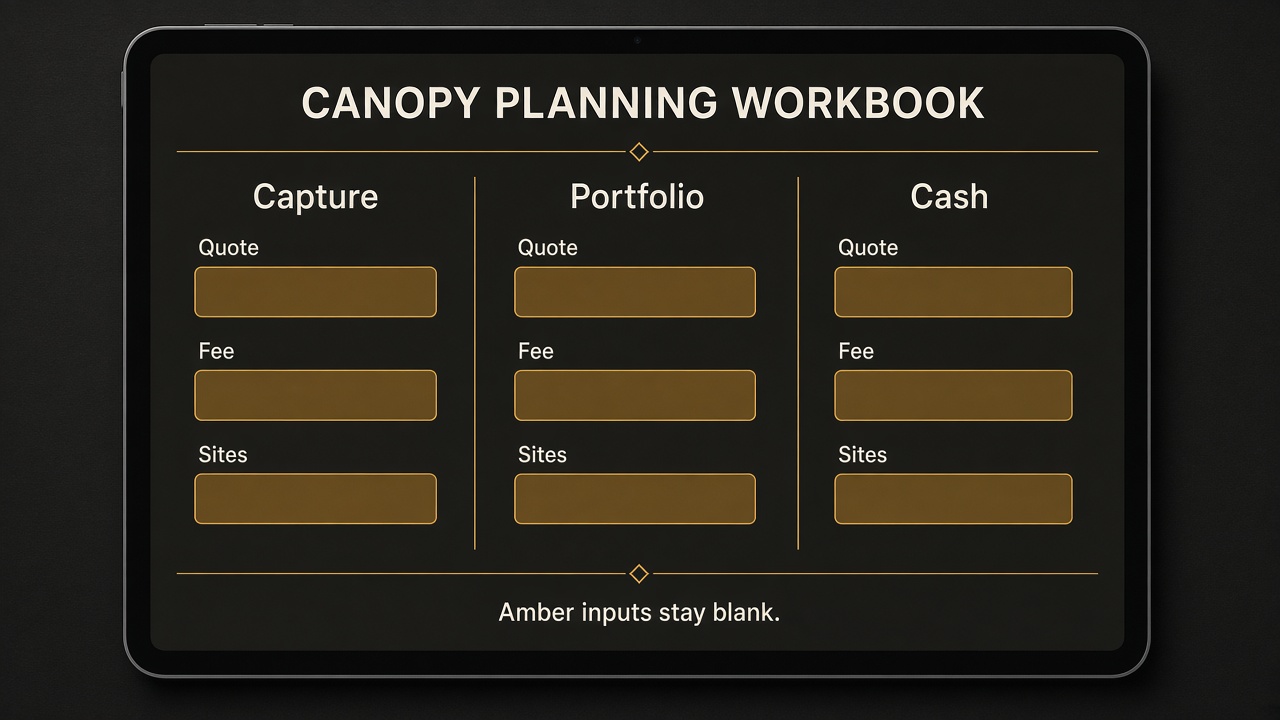
R2 multi-sector model guide
ADDED 15 September 2026 · R2
Open Canopy_Multisector_Models_2026-09-15_R2.xlsx. This is the expanded planning workbook. The R1 agriculture/valuation workbook is retained for reference; do not add its totals to R2.
Model 1: capture marketplace economics
Enter the actual customer quote in GBP, its tax rate, agreed take rate, a distinct net booking fee, and measured payment, coordination, production, rework and acquisition costs. The build calculates net service value, Canopy fees, operator net entitlement and contribution before/after acquisition. Operator entitlement is not operator profit or the final cash settlement including taxes.
The UK Basic package reference is GBP195 including VAT. A separately labelled standard-rate 20% VAT normalisation yields GBP162.50. The model never uses this competitor reference as an actual Canopy quote. US prices remain in USD; no FX assumption is inserted.
Model 2: portfolio operating model
October 2026–September 2027, company inputs in GBP. Average billable sites multiplied by a signed monthly site fee create software revenue. Accepted capture volume multiplied by service value creates gross service value; only the agreed Canopy fee contributes to agent-model revenue. Accepted programme net fees are entered separately. Include every direct delivery cost, paid FTE, loaded payroll and other operating expense.
The site fee and capture fee must represent distinct contractual obligations. Revenue accounting must follow the actual contract; this template is inappropriate without revision if Canopy is the principal delivery provider. No published enterprise quote, Canopy fee, staffing budget or demand ramp has been invented.
Model 3: cash and programme decisions
Enter monthly cash collection, operating payments, capex, taxes, debt service, committed financing and required reserve. If collections include gross job value, payments must include operator payouts. Closing cash includes only entered committed financing. Peak funding need measures the greatest cumulative gap to reserve before new financing.
A separate programme-bid sensitivity calculates contribution if awarded, a probability-weighted result after bid cost, and the break-even win probability. Enter only costs borne by Canopy; do not deduct supplier pass-through amounts again if those amounts were already excluded in arriving at Canopy's net fee. Win probability is a required evidence-based management input. This sensitivity does not flow into revenue or cash. A tender, letter of intent or framework position is not a paid contract. The historical Ordnance Survey total bid is displayed as procurement evidence only, without annualisation.
Use and limitations
- Amber/blue cells are editable company inputs. Missing inputs produce
n.a.; enter an evidenced zero when appropriate. - Sources contain six published service/package prices, the standard VAT reference, the historical procurement and FlyNex's free-tier reference. Each retains currency and scope.
- Company prices, operator costs, programme assurance costs and actual financial history were not supplied. This is not a completed forecast, full statutory three-statement model or valuation opinion.
- All three builds were recalculated and scanned for formula errors. Disposable test values checked tax normalisation, contribution, portfolio revenue, cash roll-forward and bid sensitivity; those values were removed before export.
- Native Microsoft Excel was not available. Rendered workbook views and calculated outputs were checked in the authoring environment.
R2.1 accuracy and R&D extension — 15 September 2026
The published benchmark prices were rechecked; the workbook remains unchanged and company inputs remain blank. The integration/autonomy proposal is an uncosted research option, not an additional funded business in this forecast. Before investment, prepare supplier-backed hardware, integration, calibration, site, assurance, maintenance and staffing costs with a separate R&D allocation. Record commercial, grant and equity receipts separately. Unawarded grants must not fund the baseline runway. Do not double-count shared payroll or operator pass-through. The proposal specifies the required cost schedule; no hardware prices, grant awards, utilisation or savings were invented.
R1 workbook note (reference only)
UPDATED 15 September 2026 · R2: Use MULTISECTOR_R2.md and Canopy_Multisector_Models_2026-09-15_R2.xlsx for the expanded business model. The R1 workbook below remains a separate agriculture/valuation reference.
Added: 15 September 2026 · Release 2026.09.15-r1
Open Canopy_Three_Financial_Models_2026-09-15.xlsx.
- Job economics: converts a sourced US application benchmark into service value, then calculates Canopy and operator contribution only when agreed fees and measured costs are entered. It includes the 0.2ha parcel example from the proposal and a software revenue scale calculation at AcreConnect's published price.
- Platform operating model: October 2026–September2027 monthly account, contract-price, job, GMV, fee, cost and payroll build. No Canopy quantity, price or salary is invented. Missing inputs display
n.a.rather than zero. - Cash, funding and valuation: monthly collections/payments and financing roll-forward, cumulative funding requirement, and revenue required for the user's $1bn equity ambition after an explicit net-debt bridge and a supported valuation multiple. There is no default valuation multiple or hypothetical capital raise.
The Sources sheet retains values, dates, geography, units, URLs and limitations. Public US prices are benchmarks, not Canopy quotes or Bulgarian cost estimates. All company inputs use USD; retain a documented currency/FX basis for non-US invoices. Record each quote/invoice and owner in the model's evidence register. An explicit documented zero is valid; a missing value is not.
The baseline price data include Iowa State's March 2026 expected custom rates, AcreConnect's annual plan, Stripe US payment/Connect fees, Vercel's advertised minimum and announced financing/acquisition amounts. No paid Canopy invoices, payroll, cohort volumes, supplier quotations or bank balances were provided. Consequently the workbook is a working diligence model with populated benchmarks, not a completed company forecast.
Payment/payout configuration matters. Connect pricing includes an active-account charge, payout charges and a separately listed funds-routing component. The job model asks for the actual allocated total instead of silently assuming a particular payout frequency or omitting charges. Do not apply US fees to a Bulgarian entity without a local quote.
The operating model uses an agent-platform view: service GMV is distinct from recognized platform revenue. Have the actual principal/agent and materials/tax treatment reviewed before statutory reporting. Cash collections and payments must consistently include or exclude operator pass-through, according to the settlement arrangement. Annual SaaS recognition does not imply monthly collections.
Formula verification covers area conversion, zero versus missing fees/costs, operating arithmetic, cash roll-forward and restoration of all temporary test inputs. Recalculation and export are checked in the authoring engine; native Microsoft Excel has not been exercised in this environment.
ACCURACY UPDATE · 15 September 2026 · R2.1: Public benchmark amounts were rechecked and remain unchanged. The R1 workbook retains its explicitly dated July2026 DroneDeploy announcement reference. Current acquisition status is completion reported9September2026; see S46–47 in the current source register. Do not repeat the historical “closing not verified” wording as current status. No company forecast or autonomy deployment budget has been filled.